
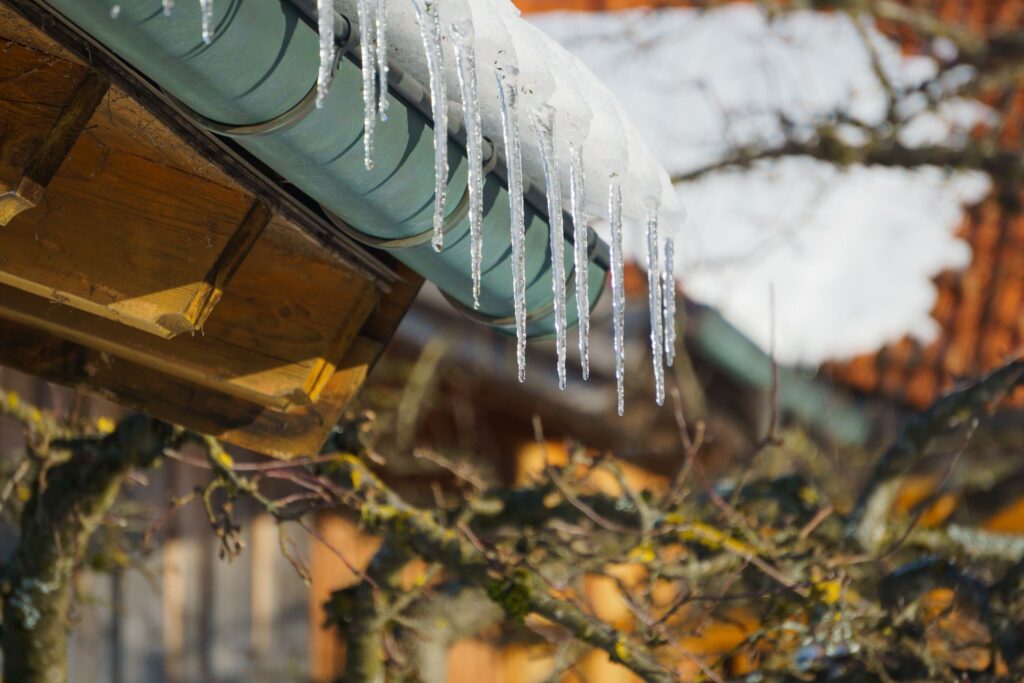
Ice dams on roof edges and condensation in the attic during winter can lead to expensive roof and interior repairs, mold remediation, and other significant costs to homeowners. In the Pacific Northwest, conditions are often considered ideal for these issues.
In the past, ventilation was seen as the main solution. However, recent findings show that air leakage control is the best first defense, and that relying on ventilation alone can be risky.
Here at Attic Doctor, we provide comprehensive attic solutions for homeowners in the Seattle area and beyond, including ice dam and attic condensation prevention.
What Are Ice Dams?
Ice dams refer to water that has frozen in ridges on the roof, usually in the eaves, blocking drainage via gutters. This can lead to significant damage to your home’s roof, ceilings, walls, and more.
Ice dams are a relatively simple phenomenon with a more complicated cause. Fortunately, increasingly successful solutions are being offered today due to a better understanding of how ice dams form.
The leading cause of ice dam formation—warm air in the attic—can also cause condensation in the attic, making mold growth more likely.
Causes of Ice Dams and Condensation in the Attic
Just three things are required for ice dams to form, according to UMass Amherst:
- snow on the roof
- a poorly sealed/insulated attic
- freezing temps
These weather conditions are present during much of the winter as well as during colder parts of the spring and fall in the Pacific Northwest, making homeowners here particularly susceptible.
In fact, as little as 2 inches of snow on a roof can create the right conditions for ice dam formation, according to building research scientists.
Here’s how the pieces come together …
Warm air rises, leading to pressure at the top of homes and other buildings. If any leaks are present, such as around chimneys, recessed lighting, etc., warm and often humid air will enter the attic.
In the winter, this can lead to two main issues: ice dams on the roof and condensation in the attic.
- Ice dams form when this now-warmer attic air heats the underside of the roof, causing snow to melt, wash down the roof, and refreeze when it hits the colder edges.
- On the attic rafters and sheathing, condensation and frost can also form due to the transfer of warm, humid air into the attic, creating ideal conditions for mold growth. The more humid the indoor air, the more problematic air leakage into the attic space is. Even when homes are up-to-code in attic ventilation and ceiling air tightness requirements, humid air seeping into the attic is still the leading cause of troubled attics and high moisture content in attic sheathing, according to the recent BC Housing Attic Ventilation and Moisture Research Study.
And, even without air leakage into the attic, homes in our region experience ideal conditions between September and March for mold growth due to the moisture levels present in attic plywood. On cold nights followed by sunny days, coastal homes have also been shown to experience 90-96 percent humidity in the attic.
Solutions for Preventing Ice Dams and Condensation in the Attic
In the past, the main method for preventing ice dams and condensation in the attic was ventilation of the attic space. This exchange of outdoor air intends to keep the attic cooler and drier.
Keeping attic air temperatures below 32 degrees (freezing) when it’s in the low 20s outside significantly reduces the formation of ice dams, according to research conducted by building inspectors in Muskegon Township.
Several recent studies have shown, however, that even up-to-code ventilation doesn’t necessarily protect from ice dams and condensation, with a high percentage of air still coming from inside the home.
This is why the best protection comes from air sealing, with humidity control in the home as a supporting solution, along with proper ventilation and insulation.
“The most important step is to seal all of the air leaks from the conditioned space into the attic space to keep warm air from entering the attic in the first place,” reports Joseph Lstiburek, a leading building scientist with Building Science Corporation, emphasizing the primacy of air sealing to deter ice dams and condensation.
If insulation is added to a leaky ceiling without addressing the leaks, condensation can actually increase due to the now-colder attic air having a lower moisture capacity, causing the relative humidity to rise faster.
It’s also recommended to keep relative humidity in the home to around 30-40 percent to prevent attic frost and condensation.
Whole-house ventilation can also help prevent mold growth. Aim for a rate of .35 to .7 air changes per hour, as homes with lower rates experience significant condensation and mold growth, including in the attic.
Recent Case Studies
The following exemplify the need for air sealing to prevent ice dams and condensation:
- In “Ice Damming: Case Studies in Diagnosis and Remediation,” researchers found that greater air leakage from the living space resulted in higher temperatures in the attic and more ice dams. Sealing of block party walls, attic hatches, and electrical boxes proved successful in prevention.
- In one home, attic temperatures dropped and ice dam formation was drastically reduced or eliminated following the sealing of gaps in floor framing and knee walls (up to 200 millimeters) as well as attic hatches and electrical gaps. Prior to this, insulation measures had not been sufficient to prevent ice dams.
- Air sealing at the ceiling plane and adding insulation allowed another home to achieve a drop in air leakage from 7.3 ACH50 to 4.1 ACH50, with a subsequent drop in heating usage from 5.5 BTU per square foot to 3.82 BTU per square foot. This significantly reduced ice dam formation in the following winters while saving the homeowner money on electrical costs.
- In another example, the owner opted instead for an insulation solution, at a cost of about $8,617, which was successful in eliminating ice dams. The building was retrofitted with 8 inches of rigid polyisocyanurate foam above the existing roof sheathing, as well as new underlayment and shingles.
Benefits of Taking Action to Protect Your Home From Ice Dams and Condensation
The main benefit of taking precautionary action is the money you’ll save—not only in terms of potential damage prevention, but also in energy costs.
Although the cost of ice dams for Seattle residents has yet to be calculated, we do know that winter storms and icing events in general can be very costly. For instance, a recent icing and wind event in the Portland area caused $1.7 billion in damage to homes, businesses, vehicles, and infrastructure, the National Oceanic and Atmospheric Administration (NOAA) reports.
Preventing Damage to Your Home
In the U.S., the average cost of water damage and mold remediation due to ice dams and condensation is almost $7,000 ($6,907), which breaks down as $3,000 for mold removal; $1,362 for repairs to roof beams; $1,000 for roof repairs; $550 for replacement of drywall; and just under $1,000 for carpet replacement.
Other estimates show ice dam-caused roof damage to cost between $500 and $5,000. If full replacement of an asphalt shingle roof is required, the cost was estimated to be $14,959 in 2023.
When it comes to attic mold, remediation is estimated to cost an average of $2.90 to $6 per square foot in the western U.S., including the PNW. Structural repairs or remediation of black mold can significantly increase these estimates, to more than $10,000 per home.
Removing ice dams costs, on average, $1,200.
Conserving Energy
In addition to avoiding these or other remediation costs, prevention efforts are also shown to save homeowners money on energy use. The U.S. Environmental Protection Agency (EPA) reports that air sealing and insulation result in an average savings of 15 percent on heating and cooling costs.
Attic Doctor Can Help
Attic Doctor is an attic and crawl space specialist based in Bellevue, Washington, serving homeowners in the Greater Seattle area with comprehensive home comfort and maintenance solutions. We focus on improving indoor air quality, energy efficiency, and structural health by addressing common attic and crawl space issues that can affect comfort and utility costs.