
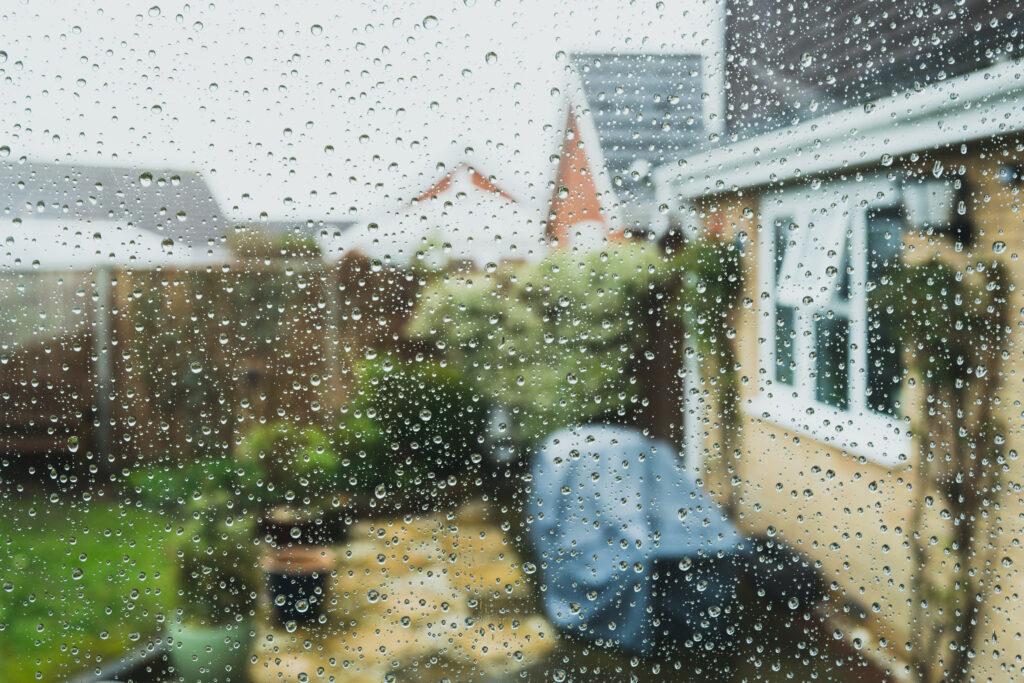
After long stretches of rain, we often get calls from customers wondering why their homes smell musty all of a sudden. It’s tempting to simply blame the weather. After all, rain does change the smell outside, raises humidity, and makes everything feel a little damp. In this region, we definitely get our fair share of rain, so when musty odors show up inside, especially when the smell reliably returns after a storm, we start to look for something else as the cause.
Usually, the culprit is moisture. A musty smell isn’t necessarily proof that there’s a major mold problem. It’s just a useful warning sign that moisture may be getting somewhere it shouldn’t, or lingering somewhere it shouldn’t. The Environmental Protection Agency (EPA) specifically recommends investigating areas that smell musty to determine whether water has entered and mold is growing. This distinction really matters. Spraying some air freshener might cover the odor for an afternoon, but it doesn’t change or stop what’s causing it.
Rain Can Expose a Moisture Problem That Was Already There
One thing that often surprises the homeowners who contact us at Attic Doctor is how quickly a relatively ordinary rainstorm can change conditions inside a house. Rain can enter through a roof or around flashing. Gutters and downspouts can move water toward the foundation instead of away from it. Soil around the house can become saturated. In a crawl space with an exposed dirt floor, moisture can also move from the ground into the air.
The EPA recommends keeping indoor relative humidity below 60%, with an ideal range of roughly 30% to 50%. Once those humidity levels stay elevated, the conditions become much more favorable for mold and mildew. There’s a good reason the smell may seem to appear almost overnight. According to the EPA, in most situations wet or damp materials should be dried within 24 to 48 hours to prevent any mold growth.
That gives homeowners a fairly small window to find and fix anything that has happened after a leak, a storm, or a significant humidity event. Sometimes we see people focus on the room where the odor is strongest. That makes sense, but it can also send the investigation in the wrong direction. Unfortunately, the source could be somewhere else.
Your Crawl Space Could Be Part of the Problem
The interesting part about crawl spaces is that they can create two problems simultaneously: moisture and airflow. The EPA identifies crawl spaces with bare earth floors as common locations for hidden mold growth. Moisture in the soil can migrate upward and evaporate into the crawl-space air, increasing humidity.
Then comes the movement of that air. Building-science and industry sources estimate that a significant portion of the air in a home’s living area can originate in the crawl space when the building envelope isn’t properly sealed. Estimates vary, and we would be cautious about treating any single percentage as universal. Still, the underlying principle is very important. The crawl space isn’t necessarily isolated from the rest of the house.
In fact, Washington State’s building code has specifically addressed this issue, noting that moisture vapor from crawl spaces can be drawn upward through a house by stack effect and eventually contribute to condensation, mold, and rot around roof sheathing. So the musty smell you notice downstairs might not stay downstairs.
That’s one of the more counterintuitive parts of moisture problems. A crawl space can influence the air quality and odor of rooms several feet above it, particularly when moisture and air leakage are involved.
Don’t Forget the Attic
Attics are another common place to investigate, particularly when the smell seems strongest upstairs. Roof leaks are an obvious possibility, but they aren’t the only one. Moisture can also come from inside the house.
Bathroom fans, the kitchen exhaust, and clothes dryers are all designed to move moisture outdoors. If an exhaust duct terminates in an attic instead, warm moisture-laden air can collect in that space and condense on cooler surfaces. Over time, that can create exactly the kind of damp environment in an attic where mold becomes a concern.
This is why we don’t recommend assuming that a musty smell automatically means someone has a bad roof or a bad crawl space. There can be several pathways for moisture to enter or accumulate, and sometimes more than one is involved. The better questions to ask are: Where is the moisture coming from, and where is it going?
A Musty Smell Is Always Worth Investigating
There’s also a health reason not to dismiss persistent dampness. According to the Centers for Disease Control and Prevention (CDC), exposure to damp and moldy environments can cause symptoms such as a stuffy nose, sore throat, coughing or wheezing, burning eyes, and skin irritation. People with asthma or mold allergies can have even more significant reactions.
That doesn’t mean every musty-smelling house is making its occupants sick. It does mean persistent dampness is something worth addressing rather than simply masking with plug-in air freshener. Interestingly, the CDC/NIOSH has also emphasized that a thorough visual inspection and even detecting problems through musty odors can be more reliable than relying on air sampling alone when assessing damp-building conditions.
In practical terms, start with the building itself. Look for water stains, condensation, wet insulation, damaged wood, deteriorated materials, standing water, or areas that stay unusually humid. Check your gutters and downspouts. Pay attention to the crawl space after rain. Look at the attic ventilation and make sure moisture-producing exhaust fans actually terminate outdoors. We often suggest getting a moisture meter or humidity monitor because they can provide you with useful information about your house, particularly when the problem comes and goes.
Fixing the Source Is More Important Than Fixing the Smell
This is probably the biggest point we try to get across to our customers. If groundwater or surface water is reaching the foundation, drainage may need to be corrected. If a crawl space has exposed soil and consistently high humidity, encapsulation, vapor control, drainage improvements, or dehumidification may be appropriate depending on the structure.
Crawl-space encapsulation is not a tiny maintenance expense. Current consumer cost estimates put professional encapsulation at around $5,500 on average, with many projects falling somewhere between $5,000 and $15,000. Larger projects involving mold remediation or drainage work can climb considerably higher.
That may sound expensive, and for many it is. Water problems can quickly become pricey. The Insurance Information Institute reports that roughly one in 67 insured homes experiences a property damage claim caused by water damage or freezing each year. From 2019 through 2023, the average claim severity for water damage and freezing was $10,234.
Those numbers aren’t meant to suggest that every musty smell will lead to a five-figure repair. Most don’t, but they do put the importance and value of early investigation, intervention, and prevention into perspective.
What We Look for After the Rain
When a homeowner tells us the house only smells musty when it rains, we don’t consider that a minor detail. In many cases, it’s the first clue that tells us when the moisture problem is most active. We look at the crawl space and the attic, but we also look beyond them.
These are the things we ask and inspect:
- Where is the rainwater draining?
- Is the soil around the foundation saturated?
- Are there signs of condensation?
- Are exhaust ducts properly routed?
- Is there a roof or plumbing leak?
- Is the crawl space sealed from the living area?
Sometimes the answers are quite obvious, and other times it takes us a little more digging. Moisture problems don’t always follow the neat path we’d like them to. The important thing here is not to treat the smell as the problem itself. A rainy-day musty odor is often your house giving you a piece of information.
If that smell keeps coming back, especially after significant rain, it’s worth finding out what the building is telling you before a small moisture issue turns into a much larger repair. If you’re concerned, call us our team of professionals at (425) 600-3075, email us at admin@atticdoc.com, or get a free quote.