
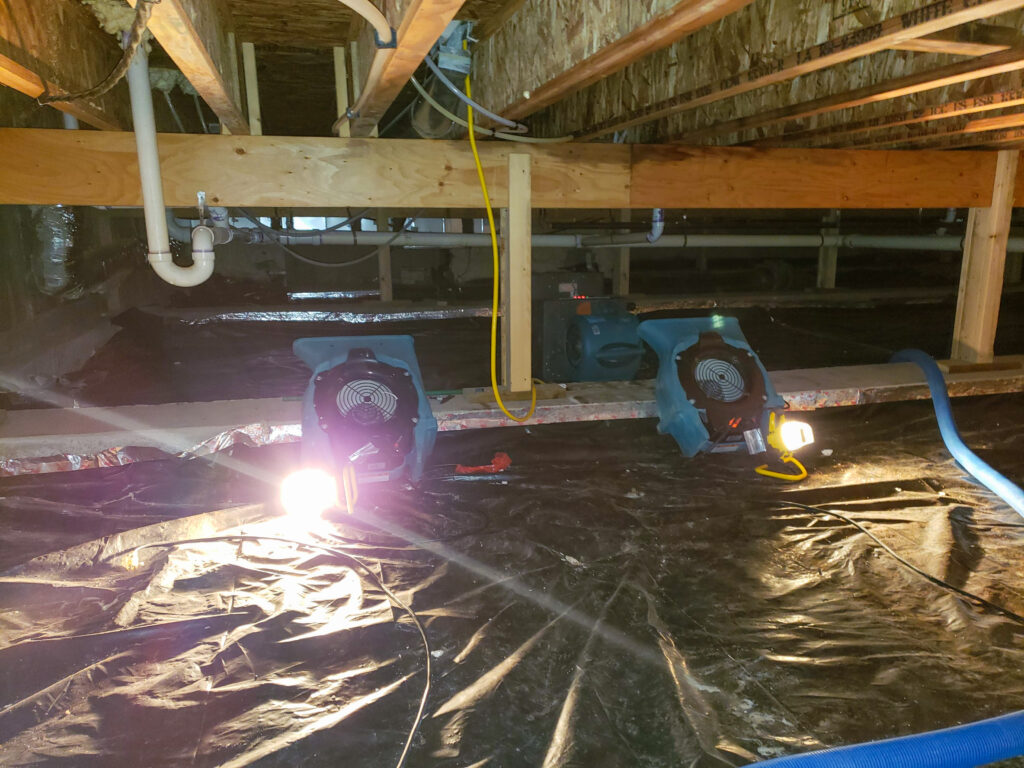
One main reason why homes have crawl spaces is to help fend off moisture and pests by elevating the home off the ground. However, these spaces are prone to moisture issues that have proved in recent years to be detrimental to air quality inside the home, cause structural damage, and more.
While it’s not only homes in humid climates that face this risk, studies show that humid and semi-humid environments do pose greater risks.
Mold growth can happen quickly in moist crawl spaces, releasing spores into the air. Soil gases and vapors like methane and radon gas can also seep into the crawl space. This air doesn’t stay under your home: Over half (50 to 60 percent) of air in the first-floor areas of homes with crawl spaces has been shown to originate from the crawl space.
The health risks are serious enough that the U.S. Environmental Protection Agency (EPA) now identifies crawl spaces as sources of indoor air pollution.
Crawl space moisture can also result in structural threats to your home and increased energy costs.
Closed crawl spaces are the engineering norm today. The remedy for homes built before 2010 often involves a multi-pronged approach, which may include sealing the crawl space, installing proper vapor barriers, and conditioning the air. These efforts have been shown to improve air quality, create more stable indoor temperatures, and save on energy costs.
“Both a moisture management strategy for the crawl space and an air sealing plan to reduce house and duct leakage should be incorporated into new and existing homes,” the nonprofit energy-engineering firm Advanced Energy advises.
Sources of Moisture in Crawl Spaces
A high-humidity climate is often a main culprit when it comes to crawl space moisture, but it is not the only one.
All sources of moisture need to be considered so that they can be addressed. Crawl spaces—known to absorb up to 20 gallons of water vapor per day—are the source of 80 percent of moisture inside the home.
Outdoor Humidity
Venting a crawl space is believed to prevent moisture under the home, but in humid climates, the opposite effect often occurs. In one recent study, 33 percent of homes in humid climates had visible moisture on vapor barriers in vented crawl spaces.
According to Advanced Energy, “In some situations, the use of foundation vents to dry a crawl space may cause additional moisture.”
Mixed-humid climates, which make up a large portion of the U.S., are also problematic, with even periodic high humidity causing moisture in crawl spaces that vents cannot mitigate.
Insufficient Vapor Barrier
Moisture from the ground evaporates into the air in a crawl space, which is then mitigated through vapor barriers. However, a recent study of homes in North Carolina with crawl spaces showed that all of them lacked full vapor-barrier coverage, with more than a quarter having no vapor barriers at all.
Plumbing Leaks
People are often unaware when their water supply lines, drain pipes, or sewer lines are leaking. Even a slow drip can lead to major problems in the crawl space, affecting your entire home.
The North Carolina study mentioned above found that 31 percent of homes had active plumbing leaks in their crawl spaces.
HVAC Condensation
About 7 percent of the homes in the North Carolina study were also experiencing leaking HVAC condensate drains in their crawl spaces. This can be caused by a clogged drain, a damaged drain line or drain pan, improper sloping of the drain line, or a frozen coil.
The Health Risks of a Damp Crawl Space
Mold and wood rot can lead to health issues and complications that may be serious.
In the North Carolina study mentioned above, almost two-thirds (62 percent) of homes had visible mold growth in their vented crawl spaces, with 67 percent having moisture levels that would support mold growth. More than one-third (36 percent) had enough moisture in their crawl spaces to support wood rot.
Research has shown that when high concentrations of Acremonium fungal species are found in crawl spaces, they also show up in first-floor areas of the home. Protocols have now been developed to test for Acremonium and other crawl-space-specific fungal species.
The Stack Effect and Indoor Air Quality
If 50 to 60 percent of first-floor air is known to come from the crawl space, and pathogens proliferating in crawl spaces are found inside our homes, how do they get in?
One explanation is the stack effect. Because warm air rises and escapes through upper levels of the home, a vacuum of sorts is created, pulling air up through the crawl space into the home. This air is known to bring with it moisture, mold spores and other pathogens, and other contaminants.
HVAC systems then distribute that air throughout the home, amplifying contamination.
The Solution? Encapsulating Your Crawl Space
Calling on a professional to encapsulate your crawl space can help keep the air inside your home fresh and healthy. It can also save you, on average, 15 to 18 percent on energy bills each year while protecting the structural integrity of your home.