
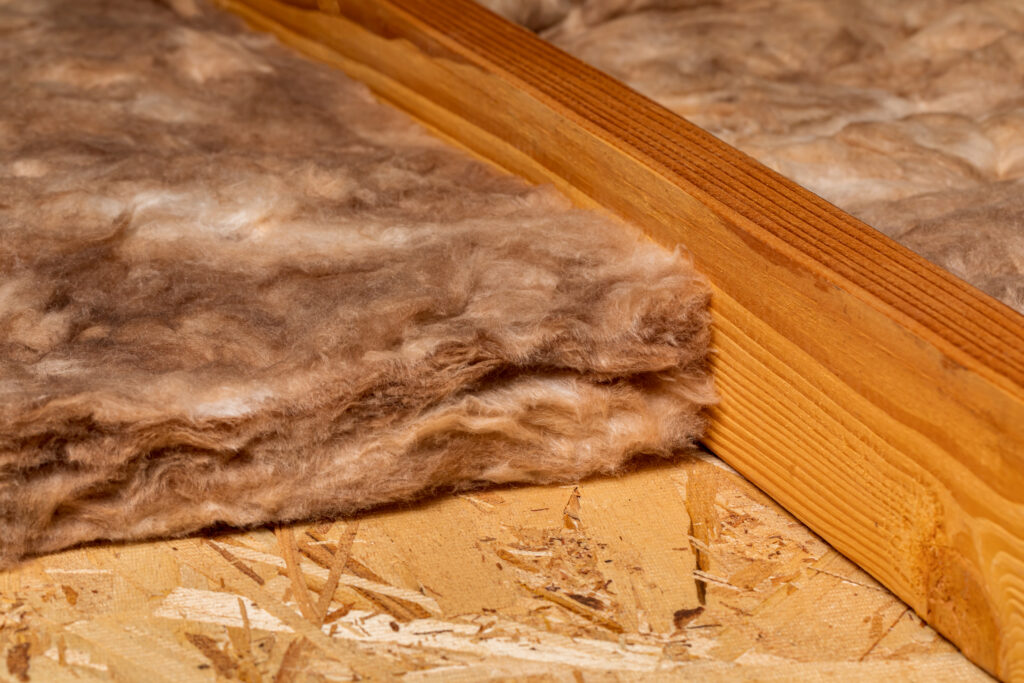
Proper attic insulation is critical, helping homeowners achieve energy efficiency, maintain healthy indoor air quality, and protect against ice dams and other property-damage risks to their homes.
Most heat is lost through the attic, and data shows that attic insulation in the average home today underperforms in energy efficiency alone at a cost of $400 annually per household.
Attic insulation ratings offer a standard system to help homebuilders and other specialists achieve proper insulation in attics. This system is based on an insulation’s thermal resistance value (R-value), or its ability to reduce heat transfer.
However, R-values aren’t static and depend on several factors. Loose-fill insulation, for example, collapses under its own weight, reducing R-value by up to 30 percent over time and increasing energy costs.
Recommended R-values also shift over time, due to factors such as climate change.
This article helps explain R-values; however, consulting with a professional is the best way to ensure proper insulation of your attic space.
What Is an R-Value?
An R-value is a figure used to indicate an insulation’s ability to slow down heat transfer, with a higher R-value representing better-performing insulation. This translates to the insulation’s ability to keep your house warmer in the winter and cooler in the summer.
How Is an R-Value Determined?
It depends on the type of insulation.
For instance, with fiberglass or cellulose fill, the R-value is determined by multiplying the thickness of the insulation in inches by 3.5. So a 3.5-inch fill provides a 12.25 R-value (often rounded down to 12 R-value).
However, R-values tend to degrade over time, so your insulation’s R-value at installation will likely be higher than it is after several years.
As one expert put it: “R-value depends on type, thickness, density, temperature, aging, moisture—it’s not static.”
With loose-fill insulation, compression and moisture are known to erase R-value gains by 20 to 30 percent after just five years.
The Right R-Value for Your Attic
Science tells us that insulation needs vary from climate to climate, home to home, and often even room to room. For example, recommended R-values for homes in warmer climates are often lower than those in colder climates.
Attics require higher R-values than walls and floors, due to increased energy loss through roofs. In homes with similar R-value insulation in their walls, those with R-60 roofs lost heat at a much lower rate (40 percent lower) than homes with R-30 roofs.
“Heat rises, so attics demand highest R-values,” a construction professional at A-Rite in Schofield, Wis., noted. “Lighter roof materials offer zero natural resistance, unlike denser walls.”
In the Seattle area (Zone 4 Marine), homes with attics that aren’t at least rated at R-49 have been shown to lose 25 to 50 percent more heat via roofs than walls. This leads to an average $300 to $600 increase in utility costs each year.
Recent changes in R-value requirements per the Department of Energy (DOE) for our area make R-60 mandatory, up from R-49, due to rising temperatures. Anything less results in 30 percent increased wear on HVAC systems, coming with $5,000 in lifetime repairs.
In warmer climates, insulation needs aren’t as great. For example, Zone 1 uninsulated attics require R-30 to R-49, or an additional R-19 to R-38 over existing insulation at 3 to 4 inches.
However, climate zones also shift, further complicating insulation needs. In 2025, 5 percent of Central homes were reclassified on climate zone maps, now requiring R-38 roofs instead of the previous R-30.
Factors That Degrade R-Value
Insulation will generally decrease in R-value over time, with factors like weight, moisture, and installation errors accelerating this reduction in performance.
Factors that degrade R-value include the following:
- Settling: Blown-in cellulose has become more popular in recent years for layering, but settling complaints have risen by 10 percent due to improper density specs. Loose-fill insulations such as these settle non-proportionally, with a 12-inch install compressing to R-30 instead of R-42. Similarly, low-density fiberglass achieves R-3.1/inch but settles faster than high-density rockwool, at R-4.2/inch.
Per one expert: “Installing more insulation increases R-value, but loose-fill settled density compresses under weight—R-value won’t scale linearly with thickness.”
- Moisture: Wet fiberglass insulation clumps, reducing effectiveness by 20 to 50 percent. Cellulose also fails in humid climates—according to recent audits, homes in humid Zone 4 climates experienced 15 to 20 percent post-install settling of uncompressed cellulose, with reinstallation costs averaging $2,000 to $4,000. Overall, aged installs can experience R-value reductions of 40 percent due to moisture.
- Uneven/Improper Installation: If not installed properly, i.e., not leveled, blown-in cellulose over fiberglass blankets can reduce performance by half where voids occur. Additionally, energy audits show that nearly a third (30 percent) of attics in homes built in the 1980s experienced 25 percent spikes in heat loss due to fiberglass batt gaps. Homeowners should also be aware that multilayer mixing can boost R-value but also traps moisture if vapor barriers are improperly installed, increasing the risk of mold growth.
- Mismeasuring: When determining the insulation’s height, measure from the floor of the attic to the top of the insulation. Measuring to compressed edges or settled fill can skew readings by 1 to 2 inches.
Is Your Attic’s Insulation Underperforming?
Our professionals can determine if your insulation needs updating and discuss the best options with you. We’re here to help!