
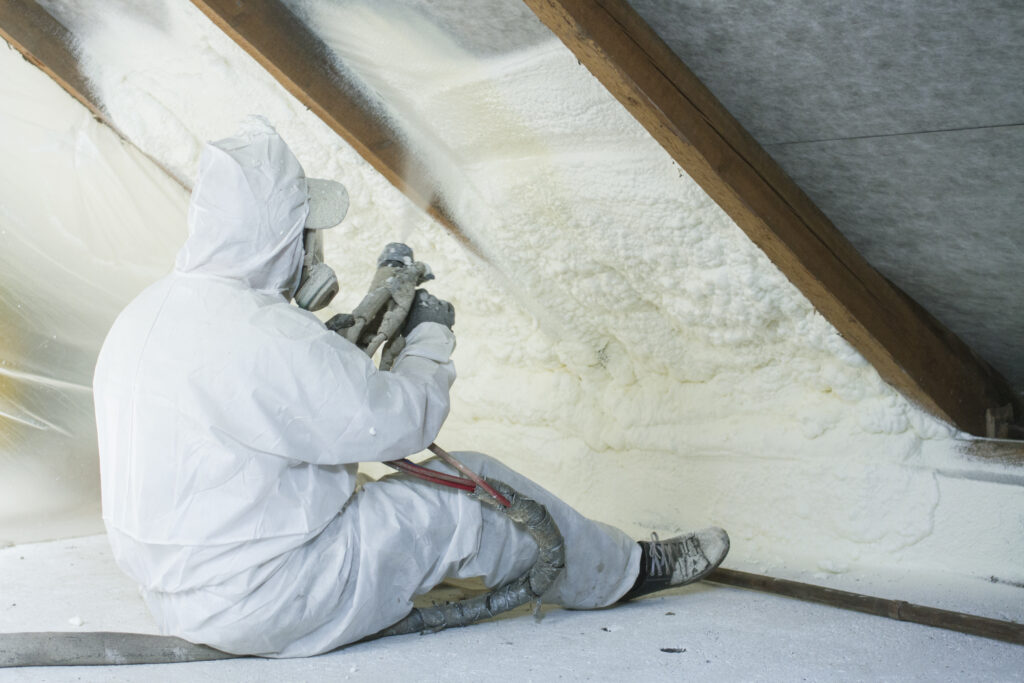
Sealing your attic with spray foam is often marketed as the ultimate upgrade – you lower energy bills, experience improved comfort, and maintain a tightly controlled indoor environment. And, more often than not, it can deliver on those promises.
However, here’s where there are challenges.
Manufacturers and installers often suggest failure rates are usually extremely low; however, real-world building science tells us a more nuanced story. While some homeowners experience long-term success, others discover hidden issues years later – long after warranties expire and repairs become costly.
So what actually happens when you fully seal your attic with spray foam? Let’s break it down.
What does “Fully Sealed Attic” Really Mean?
When you fully seal an attic with spray foam, you are basically creating what’s known as an unvented attic assembly, which is sometimes also called a “hot roof”. Instead of insulating the attic floor and allowing airflow through vents, spray foam is applied directly to the underside of the roof deck.
Spray foaming the attic typically:
- Eliminates traditional attic ventilation
- Brings the attic into the home’s conditioned space
- Creates an air barrier designed to stop heat and moisture movement
On paper, it’s a high-performance system, but in practice, the results heavily depend on execution and environmental conditions.
7 Things that Happen When You Seal Your Attic with Spray Foam
Here are seven things that usually happen when you fully seal your attic with spray foam.
- Home Becomes Significantly More Airtight
One big advantage of using spray foam is its ability to act as both insulation and an air barrier. When spray foam is installed properly, it can:
- Reduce drafts
- Stabilize indoor temperatures
- Lower heating and cooling costs
- Improve HVAC efficiency
However, something to note is that real-world testing has shown that even “fully sealed” attics can still have air leaks. Without post-installation testing, such as blower door verification, homeowners may never know if the seal is truly effective and may face issues later on if it wasn’t.
2. You Lose Traditional Ventilation
When you fully seal your attic, ventilation is intentionally removed. This means there are no soffit vents, no ridge vents and no natural airflow through the attic. Instead, moisture and heat must be managed entirely by the building envelope and HVAC system.
This shift is critical – and it’s where many long-term risks begin to emerge.
3. Moisture Can Be Trapped
One of the most overlooked aspects of spray foam is that closed-cell spray foam is highly resistant to vapor movement. What this means is that it doesn’t just block air, it also slows or prevents moisture from passing through. This seems like a good thing until moisture gets trapped.
If condensation forms inside the attic assembly (from temperature differences, humidity, or small air leaks), the foam can prevent that moisture from drying out. Instead, it stays in contact with wood framing and roof sheathing.
Over time, this creates the perfect conditions for mold growth, wood rot, and structural deterioration. The biggest challenge? These issues often develop silently, hidden behind the foam.
4. Problems May Be Hidden for Years
Timing is extremely important, and homeowners need to understand the reality of it. Spray foam issues don’t usually show up right away, and this creates a “false confidence” window where everything may seem fine, while problems are already developing behind the scenes.
Building science experts have observed that moisture-related damage can take around 8 years to become visible. Additionally, air sealing failures may appear 10-15 years after installation.
So, when issues end up being discovered, repairs can be far more complex and expensive.
5. Installation Quality Matters
Unlike fiberglass or cellulose, spray foam relies on precise chemical reactions during installation. IF anything is off – even slightly – it can lead to long-term problems.
Common issues include:
-
- Incorrect chemical mixing ratios
- Poor temperature control during application
- Uneven or insufficient thickness
- Improper surface preparation
Industry insights suggest that a large percentage of spray foam failures are tied to these processing issues and not just installer technique. This means that even reputable contractors encounter problems if conditions aren’t exactly right.
6. Hidden Defects Can Exist Inside the Foam
While spray foam can look properly installed, there could still be hidden defects you may not notice right away. These defects can include:
- Voids or air pockets inside the foam
- Delamination, where foam pulls away from the wood framing
- Gaps of missed areas that allow air leakage
The challenge is that these issues are often invisible without specialized tools like thermal imaging or invasive inspection. Once discovered, they’re difficult and, not to mention, costly to fix.
7. High Repair Costs When Issues Arise
When spray foam performs well, it’s a great long-term investment. When it fails, repairs are not that simple. Depending on the issue, remediation may involve:
- Removing sections of spray foam
- Replacing damaged wood framing or roof sheathing
- Addressing mold or moisture damage
- Reinstalling insulation properly
Costs can range widely, but major repairs can reach tens of thousands of dollars, especially if structural damage is involved. Additionally, these issues often arise after warranties expire and can leave homeowners responsible for the full cost.
Why Does This Matter in the Pacific Northwest?
The Pacific Northwest is prone to a moisture-rich climate, and these risks are amplified for homeowners. This is because the PNW experiences high annual rainfall, elevated humidity levels, and frequent temperature fluctuations.
These conditions increase the likelihood of condensation forming within building assemblies. In a fully sealed attic, that moisture has fewer ways to escape, making proper design and installation absolutely critical.
Is Spray Foam A Bad Idea?
The short answer is no. Spray foam is highly effective when it’s properly designed for the home and installed under the right conditions. Additionally, when it’s verified with post-installation testing and used in appropriate areas, it’s a great investment.
Many building science professionals are recommending a hybrid approach:
- Sealing specific problem areas like rim joists or penetrations
- Combining spray foam with traditional ventilation strategies
- Maintaining some level of airflow in the attic
This balanced approach can deliver energy efficiency without concentrating moisture risk.
What Homeowners Should Do Before Sealing an Attic
When installing spray foam, being extra diligent can go a long way. Take these smart steps:
- Request a pre-installation moisture assessment
- Ask about chemical mixing and application protocols
- Require post-installation blower door testing
- Consider a thermal imaging inspection after installation
- Discuss whether a hybrid system might be more appropriate
Most importantly, make sure you work with experienced professionals who understand not just installation but building science as a whole.
Biggest Takeaways
Fully sealing your attic with spray foam can improve your comfort and energy efficiency. However, keep in mind that it also changes how your home handles air and moisture in fundamental ways.
It’s not just about installation, it’s about the whole system.
A well-executed spray foam attic can perform amazingly, while a poorly executed one can create hidden risks that pose long-term threats as they take years to surface.
Be informed with your decision-making and make sure the proper tests are done for long-term success.